Guardamar’s beaches: conditions and the state of the shoreline
The current state of Guardamar’s beaches, including La Roqueta, Centre and Moncayo, maintenance work, five Blue Flags and winter warnings.
Guardamar’s beaches enter the winter of 2026 in generally good condition, with clean sand, open access points and five Blue Flags recognising the previous season. News from Guardamar’s beaches this autumn has focused on maintenance work at La Roqueta, Centre and Moncayo, the removal of summer services and occasional warnings during easterly storms. This report looks at the condition of each stretch, what visitors can use now and how to enjoy the coast during the colder months.
The municipality has eleven kilometres of coastline and an 800-hectare pine forest that acts as a natural barrier against wind and sand (Guardamar Turismo, 2025). This balance between beach and woodland shapes the condition of the shoreline throughout the year and explains many of the works carried out each autumn along the seafront, from cleaning up after storms to looking after the dunes.
What are the beaches at La Roqueta, Centre and Moncayo like now?
Guardamar’s three central beaches are clean and accessible, with the sand raked and the promenades open. La Roqueta is 1,164 metres long, Centre just 427 metres and Moncayo stretches for 1,451 metres (Guardamar Turismo, 2025). These are the stretches most used by residents in winter because they are close to the town centre.
Centre beach is the most urban. It lies beside Avinguda Ingeniero Codorníu and the promenade, so residents, older people and families out for a walk pass through every day. Its short length makes it a handy choice for anyone looking for a compact, well-connected stretch, with bars and shops just metres away.
La Roqueta, to the south, remains a family-friendly beach with wide access points from the car park. There is still plenty of sand after the summer, and the beach looks stable, without the gullies that autumn waves sometimes leave behind. It also has the best adapted facilities in the municipality.
Moncayo completes the group towards the edge of the pine forest. It is wider and more open, with low dunes and vegetation separating it from the car park. In the low season, it offers peace and quiet, making it ideal for a longer walk. The sand is in good condition and the wooden access walkways have been checked.
For anyone wanting to explore further, Guardamar has eight beaches. Nearby Playa Babilonia de Guardamar deserves a section of its own because of its historic houses and its particular position by the sea.
Which beaches does Guardamar have, and how long is each one?
Guardamar del Segura has eight beaches along its coastline, from urban stretches to the natural sandy beaches in the south. El Camp is the longest, at 2,021 metres, followed by Tossals at 1,661 metres and Ortigues at 1,457 metres (Guardamar Turismo, 2025). Knowing what each stretch is like can help you choose the right one for your plans.
From north to south, Vivers begins the line-up with 1,210 metres of sand beside the pine forest. Next comes Babilonia, 1,060 metres long and recognisable by its row of historic houses right by the beach. Then come the central stretches: Centre, at just 427 metres, and La Roqueta, at 1,164 metres. Both are closely connected to the town centre.
Further south are the wider, more natural beaches. Moncayo is 1,451 metres long, El Camp reaches 2,021 metres and Ortigues stretches for 1,457 metres to the boundary with the river mouth. Tossals, at 1,661 metres, is the municipality’s naturist beach, set further apart and with a more wild character.
This variety explains why the shoreline is not in the same condition everywhere. The urban stretches receive more cleaning and supervision, while the natural beaches to the south retain living dunes and vegetation shaped by the wind, with little human intervention. Each stretch responds differently to winter storms.
What maintenance work is carried out on the shoreline?
Coastal maintenance steps up at the end of the high season, with beach cleaning, checks on walkways and work to keep access points in good condition. This is an ongoing task in a municipality with eleven kilometres of coastline (Guardamar Turismo, 2025), where wind and sea continually reshape the sand.
Municipal crews remove rubbish, seaweed and plant debris deposited by the waves after autumn storms. They also put back the wooden walkways displaced by the sea and repair sections damaged by machinery and visitors during the summer.
Sand is another part of the job. Westerly and easterly winds shift the shoreline and, in some places, pile sand against the dunes or promenades. Adding and redistributing sand helps maintain the width of the beach and protect the foot of the dunes, the most fragile part of the system.
The pine forest also needs attention. Covering 800 hectares with pines, palms and eucalyptus planted from the late nineteenth century onwards, it needs undergrowth cleared, fallen pines removed and paths maintained (Guardamar Turismo, 2025). This green lung and the dunes form one natural system with the beach.
Is the beach accessible in the low season?
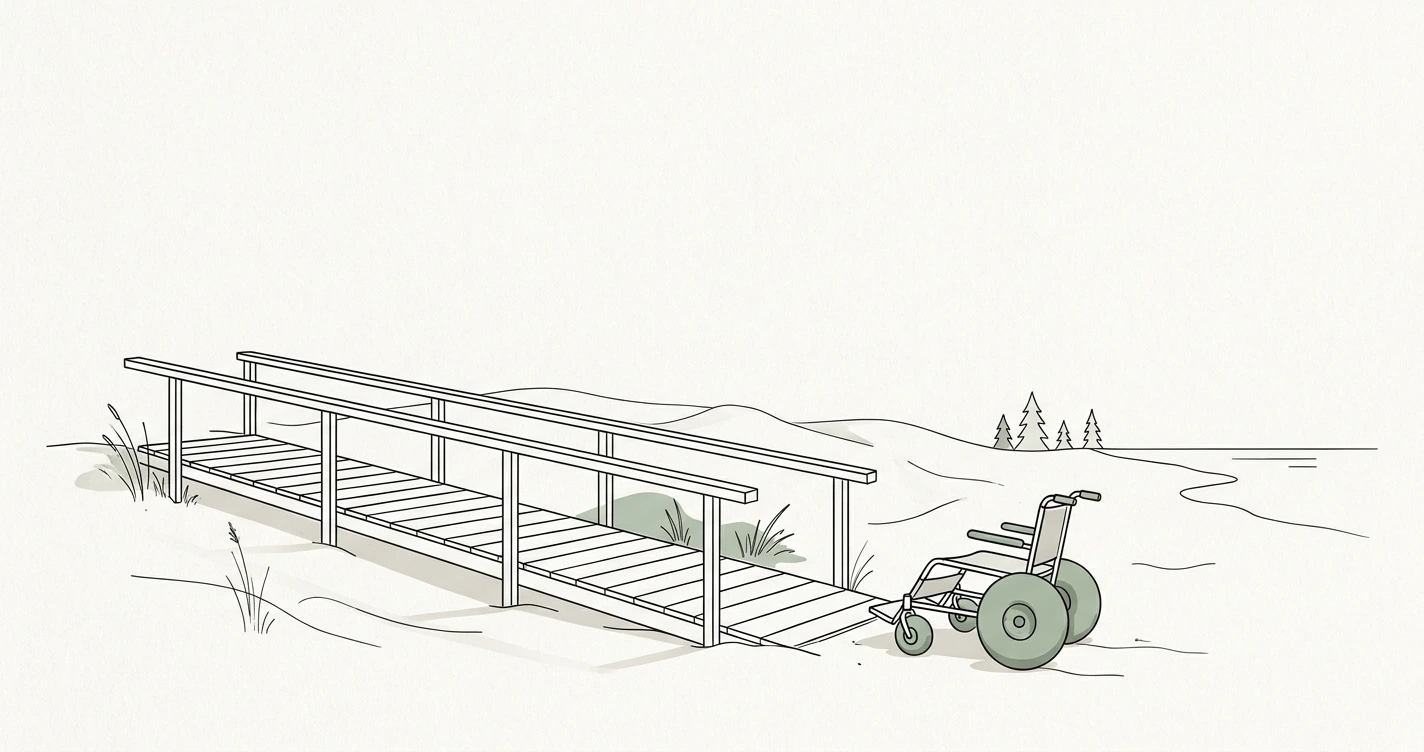
Much of the shoreline remains accessible throughout the year, although the full range of adapted facilities is mainly available during the bathing season. Guardamar has three accessible beaches, with La Roqueta the main one thanks to its amphibious chair (, 2026).
La Roqueta has walkways across the sand to the water’s edge, adapted toilets and showers, and reserved parking spaces. The amphibious chair allows assisted bathing for people with reduced mobility. This service is mainly available in summer, with lifeguard support.
Moncayo and Vivers complete the municipality’s network of adapted access points. Their walkways allow visitors to get close to the water without crossing loose sand, which is important for older people, families with pushchairs and wheelchair users taking a winter stroll along the seafront.
Out of season, the main walkways remain open, although some seasonal facilities are removed to protect them from storms. Before setting out, it is worth checking which services are still operating by calling the Ayuntamiento (Town Hall) or looking up the useful phone numbers for Guardamar del Segura.
How many Blue Flags do Guardamar’s beaches have?
Guardamar del Segura has five Blue Flags for the 2025 season, one of the best results on the Vega Baja coastline. The awards went to Vivers, Centre, La Roqueta, Moncayo and Ortigues-Campo (Guardamar Turismo, 2025). The Blue Flag recognises water quality, services, safety and environmental management.
The year’s new award went to Ortigues-Campo, which won a Blue Flag for the first time (Vega Baja Digital, 2025). This stretch, more than two kilometres long when Camp and Ortigues are counted together, is the largest in the municipality and one of the most natural.
The result is part of a strong showing across the province. Alicante province leads the national ranking with 89 Blue Flags, within the 164 awarded across the Comunitat Valenciana in 2025 (Valencia Plaza, 2025). Guardamar makes a notable contribution to the county-wide total.
The Blue Flag is a mark for the bathing season and is not raised in winter. Its value is felt throughout the year, however: it reflects ongoing management of the shoreline, water and services, which residents can see when the beach remains clean and well cared for even in the colder months.
What are water quality and services like outside the summer?
Water quality in Guardamar is good and is monitored by official bodies, although intensive testing takes place mainly during the bathing season. The five Blue Flags show that the water meets the required standards (Guardamar Turismo, 2025). In winter, bathing is not supervised and services are reduced.
In the low season, facilities such as sunbeds, hired parasols, seasonal beach bars and the lifeguard service, with its green, yellow or red flags, are removed or scaled back. Anyone who swims outside the summer does so at their own risk, with no active supervision on the shore.
Permanent facilities remain open: seafront promenades, lighting, bins, foot showers at designated points and car parks. The beach continues to be cleaned, with the frequency adjusted to lower visitor numbers and storm events that bring seaweed and debris ashore.
For residents, winter changes how the beach is used more than whether it is available. Where summer brings parasols, lifeguards and ice-cream stands, January brings open sand, the promenade and the woodland. It is worth bearing this difference in services in mind before coming down with children or older people, who will not find the seasonal lifeguard stations or play equipment in the low season.
The natural surroundings are winter’s greatest asset. The pine forest, with its paths and picnic areas, remains open and offers shade and shelter from the wind. Around 80% of the municipality’s area has some form of environmental protection status (Guardamar Turismo, 2025), which shapes how these places are used and cared for.
What storm and sea-condition warnings should you watch for?
Storm warnings shape much of the coastal news in autumn and winter, when easterly winds and low-pressure systems stir up the sea off Guardamar. Official information comes from AEMET and Protección Civil, which issue yellow, orange and red alerts depending on the strength of the wind, waves and rain.
The easterly wind causes the most damage to the shoreline. It drives waves against the beach, erodes the foot of the dunes and shifts sand and walkways. After these events, the municipality assesses the damage and plans clean-up work and the replacement of material moved by the sea.
The mouth of the River Segura, at the northern end of the beaches, is another area to watch. Heavy rain in the river basin can increase the flow and affect the gola, where fresh water meets the sea. It is a sensitive spot that is often covered by warnings when storms at sea coincide with rising water levels.
Before approaching the water’s edge on alert days, follow any access closures and do not walk on the dunes or breakwaters. La Gaceta de Guardamar publishes coastal conditions and local alerts; for a broader picture of the weather, it is useful to check the November weather on the Alicante coast.
Safety tips for swimmers and walkers in winter
Swimming or walking by the water in winter calls for caution because there are no lifeguards or safety-flag system outside the bathing season. Waves are the main danger: easterly storms produce powerful surf and rip currents that can be hard to spot from the sand. Going into the water on those days is unwise, even for experienced swimmers, because there is no lifeguard cover and the sea is cold.
Breakwaters and rock groynes are another hazard. Rough water and slippery rocks can cause falls, so avoid fishing or leaning out over the sea from these structures during warnings. For walks, the rule is simple: keep off the dunes, respect the fences protecting the vegetation and stick to marked paths and walkways. This protects the dune system, the beach’s best natural defence, and keeps people away from unstable areas after a storm.
What can you do along the coast in winter?
Guardamar’s coastline offers walking, sport and nature in winter without the summer crowds. With eleven kilometres of coast and 800 hectares of pine forest, the municipality has miles of paths and open sand to enjoy all year round (Guardamar Turismo, 2025). The mild Costa Blanca climate makes it possible to get out even in the middle of December.
The simplest plan is to walk along the shore from La Roqueta to Moncayo and continue towards Vivers, with the pine forest on one side and the sea on the other. In the low season, the wide stretch of sand allows for long, peaceful walks, ideal for gentle exercise and fresh air.
The pine forest adds routes through the pines and dunes. The paths link car parks, recreational areas and viewpoints overlooking the sea. For a longer outing, the walking routes around the mouth of the Segura offer a guide to trails combining woodland, river and coast.
Outdoor sport rounds out the winter options. Running along the promenade, cycling on the lanes beside the beach or taking part in water sports when the forecast is good are all popular with residents and visitors. Guardamar’s coast, where winds are frequent, is also a well-known spot for windsurfing and kitesurfing when conditions are favourable.
Why do the pine forest and dunes affect the condition of the beach?
The pine forest and dunes are Guardamar’s natural shield and help explain why its beaches withstand storms better than other stretches of coastline. The forest began with a project approved in 1897 to stop advancing dunes from reaching the town. More than 600,000 trees were planted in the first decades of the twentieth century (Guardamar Turismo, 2025).
That planting stabilised the sand and prevented the dunes from burying houses and farmland. Today, the same system protects the beach: the dunes absorb the force of waves and wind, while the pines hold the ground in place. Damaging the vegetation weakens the entire seafront’s natural defences.
That is why municipal work looks after the beach and the woodland together. Replenishing sand, closing access points that damage the dunes and keeping paths within marked routes are all part of the same conservation strategy that helps maintain the shoreline.
This history explains the character of the town. After the 1829 earthquake, Guardamar was rebuilt facing a sea and dunes that
This is an automatic translation of an article originally published in Spanish by La Gaceta de Guardamar. If in doubt, the Spanish version prevails. Read the original · More news in English